Signed in as:
filler@godaddy.com

The Gaiwan is a unique piece of tea-ware. Originating from China, its design appeared in the 17th century at the time of Manchu Qing Dynasty. Manchu, who conquered China, had lost their heart to its sophisticated, refined and highly spiritual culture which assimilated them entirely. Emperors of Qing dynasty became adepts of tea. In this p
The Gaiwan is a unique piece of tea-ware. Originating from China, its design appeared in the 17th century at the time of Manchu Qing Dynasty. Manchu, who conquered China, had lost their heart to its sophisticated, refined and highly spiritual culture which assimilated them entirely. Emperors of Qing dynasty became adepts of tea. In this period the tea business has been rapidly developing with the variety of tea houses opening around the country and major part of its inhabitants’ drinking tea.
The name of gaiwan itself translates as a cup with a lid. Initially gaiwan, used for individual tea drinking, eventually it started to be used for steeping tea and pouring it into cups.
A porcelain gaiwan is universally applicable for brewing of any tea, be it a green tea or pu’er. Therefore, it fits the best for introduction to the Chinese tea culture.
Experiment with water temperature and your tea-ware beforehand. Boil up water, pour it in your Gaiwan 盖碗 and keep watching over its condition, measuring the temperature with the thermometer to familiarize yourself how the water will behave at each stage. Doing so will familiarize you with how it warms up the Gaiwan 盖碗 , Chahai 茶海 and, Ch
Experiment with water temperature and your tea-ware beforehand. Boil up water, pour it in your Gaiwan 盖碗 and keep watching over its condition, measuring the temperature with the thermometer to familiarize yourself how the water will behave at each stage. Doing so will familiarize you with how it warms up the Gaiwan 盖碗 , Chahai 茶海 and, Chábēi 茶杯 and how fast it cools down. Keep your hand over it and sense what heat radiates at different temperatures.
At the time of brewing, a thermometer is inappropriate to use, it becomes auspicious when you familiarize yourself with the water and your tea-ware. If you are using a glass kettle, attempt to bring the water to a boil with a thermometer, notice what kind of bubbles appear at different temperatures. In a word, take a time with water and thermometer prior to your tea session.
The Gaiwan 盖碗 must be held with one hand to while pouring into the Chahai 茶海 while at the same time filtering the tea leaves. Depending on the Gaiwan 盖碗 is made of, the temperature, of your brew, and your pouring technique, this could be quite hot to sensitive hands. You will master it after several steeping’s, but at first it will appear and feel awkward.
Use well filtered or good quality bottled water. Tap water has chemicals, additives, deposits, and other un-wanted material that will affect the tea flavor.
Measure the required amount of tea and cast it into Chahe茶荷.
Set out tea-ware.
Boil water.
Acquaint yourself with the tea leaf in Chahe | 茶荷. In China it is customary to contemplate the tee and for us is more common to smell it. The aroma is inhaled as follows, hold the wide side of Chahe | 茶荷 to your nose, using both palms. Inhale and after
Measure the required amount of tea and cast it into Chahe茶荷.
Set out tea-ware.
Boil water.
Acquaint yourself with the tea leaf in Chahe | 茶荷. In China it is customary to contemplate the tee and for us is more common to smell it. The aroma is inhaled as follows, hold the wide side of Chahe | 茶荷 to your nose, using both palms. Inhale and after a short pause exhale warm air onto the tea leaf, inhale and hold your breath again. To estimate the depth of the aroma you should inhale up to three times.
Preheat the tea-ware, this prevents tea-ware from drawing heat from the steeping’s. This should be done as follows, pour some water in empty Gaiwan 盖碗, then from Gaiwan 盖碗 to Chahe 茶荷, and from Chahe 茶荷 to teacups. Afterwards water from teacups is dumped in a Chápán 茶盘 or a tea Cháchí 茶池. You may immediately take advantage of this procedure and find out if the capacity of Gaiwan 盖碗is sufficient for all guests. Should you fill the teacups full, to the middle or just cover the bottom slightly. Don’t forget that by the third steeping, the tealeaf in there will take up 1/3 of Gaiwan 盖碗 volume.

Throw the tea in the warmed Gaiwan 盖碗, cover with the lid, shake it a little, and try the aroma again which now is much brighter even without in and exhaling.
Steep the tea with water of the respective temperature using the chart above.
Pour the tea into Chábēi 茶杯immediately, the lid should be crack open slightly as not to let the tea leave
Throw the tea in the warmed Gaiwan 盖碗, cover with the lid, shake it a little, and try the aroma again which now is much brighter even without in and exhaling.
Steep the tea with water of the respective temperature using the chart above.
Pour the tea into Chábēi 茶杯immediately, the lid should be crack open slightly as not to let the tea leaves slip out. If this is hard to do or the tea leaf is too small you can use the sieve/strainer. There is no disgrace to put the tea back in Gaiwan 盖碗 from the sieve/strainer if it slipped out in abundance.
The first steeping of Oolong and Pu’er is to be disposed of. You may use it for repeated preheating of cups, pour it off in a Chápán 茶盘, or offer a cup to your Tea Pet. Next steeping with no delay is poured into Chábēi 茶杯.
From chahai the tea is distributed between teacups. There are several options to take if the cups are full, but there’s some tea remaining in the chahai. First Option, pour it off in the chapan or shower the Tea Pet. Second option, evenly add the tea to all teacups. Third Option, retain it and drink another round. This is appropriate when
From chahai the tea is distributed between teacups. There are several options to take if the cups are full, but there’s some tea remaining in the chahai. First Option, pour it off in the chapan or shower the Tea Pet. Second option, evenly add the tea to all teacups. Third Option, retain it and drink another round. This is appropriate when the tea is plenty, and the guests are few. The extra tea is not a problem, it is much worse when one of guests is left deprived.
Every time pay attention to how much tea should be poured in the teacups in order to distribute it evenly as the tealeaf may keep swelling up to the 6-th steeping and occupying the internal space increasingly with each steeping, retaining less space for water.
Generally, the first cup is handed over to the guest and the rest he takes by himself. In China the teacup remains with the guest and the tea is filled up wherever he leaves it.
Proceed with the steeping’s. Pour in water and at once pour off the infusion into chahai. If after 5-10 steeping’s you will sense that the flavor has reached its climax and started to decline, you may increase each consecutive steeping by adding 10, 20, 30 seconds to it.
Keep steeping to the moment which you consider appropriate for the given tea. Control temperature of the water, using the kettle maintain the temperature by periodic heating to the respective level thereof, otherwise, your tea will brew incompletely.
Good Chinese teas withstand much steeping’s, see chart above, however in practice the nu
Keep steeping to the moment which you consider appropriate for the given tea. Control temperature of the water, using the kettle maintain the temperature by periodic heating to the respective level thereof, otherwise, your tea will brew incompletely.
Good Chinese teas withstand much steeping’s, see chart above, however in practice the number of steeping’s depends on several factors such as tea variety, water temperature, choice of tea-ware, steeping time, and your taste preferences. Many teas will wear off smoothly, some will end up unpalatable, mind you own senses.
Concluding the tea session, express gratitude to your guests for sharing this tea and time with you. Do not postpone washing of tea-ware especially when it comes to sieves and chapans. They may be spoiled by dried out tea. Use detergents only for teacups, for the rest of tea-ware rinsing and wiping is sufficient.
Everyone works out their own brewing practices. Some like to do it most natural way with the minimal set of utensils. Others, on the contrary, are eager to acquire any article that could be used in the brewing process. This majorly depend on the mentality of a person as both these approaches are not axiomatic. But the set of tea utensils is better to be enlarged in steps. For example, if you feel that wet foot of a teacup distracts you, buy a tea towel and wipe the bottom of a cup before handing it over. If you dislike tea leaves slipping into chahai, buy a sieve. But if you disregard the following inconveniences, then you need neither a sieve nor a towel. Pin cha does not impose any strict rules of provisions
Gong Fu Cha 功夫茶 translates as, making tea with skill, or making tea the correct way.
Gong Fu Cha 功夫茶 is a traditional Chinese tea brewing method that involves brewing small amounts of concentrated tea for short intervals, which are repeated several times. This method allows the tea leaves to be brewed in succession, capturing the subtle essences of flavor and aroma as they are released from the tea leaves.
Gong Fu Cha requires knowledge and a skillset, typically performed using a Gong Fu tea set, which includes a small Gong Fu teapot 茶壶, pitcher 茶海, and cups 茶杯. The process also involves using a bowl or vessel 茶池 that is big enough to hold the brewed tea leaves as well as the discarded rinse water before and after brewing.

Gong Fu Cha 功夫茶 Traditional Ceremony is traditionally used in brewing Oolong tea but can be used with any tea variety. There’s no right or wrong way to brew tea. The Gong Fu Cha method is just one approach that captures the essence of tea. Feel free to experiment and adjust according to your taste preferences.
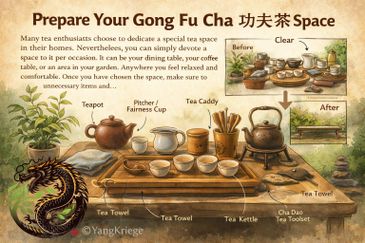
Many tea enthusiasts choose to dedicate a special tea space in their homes.
Nevertheless, you can simply devote a space to it per occasion. It can be your dining table, your coffee table, or an area in your garden. Anywhere you feel relaxed and comfortable. Once you have chosen the space, make sure to clear it of unnecessary items and
Many tea enthusiasts choose to dedicate a special tea space in their homes.
Nevertheless, you can simply devote a space to it per occasion. It can be your dining table, your coffee table, or an area in your garden. Anywhere you feel relaxed and comfortable. Once you have chosen the space, make sure to clear it of unnecessary items and distractions. Wipe the dust and make sure it's ready for your mindful tea ceremony.
Take the time to prepare everything you will need for the ceremony, your gongfu tea set with the tea table, all the tools, and utensils. Prepare the tea itself. And don't forget your tea pet!
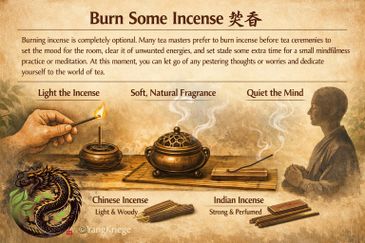
Burning incense is completely optional. Many tea masters prefer to burn incense before tea ceremonies to set the mood for the room, clear it of unwanted energies, and set aside some extra time for a small mindfulness practice or meditation. At this moment, you can let go of any pestering thoughts or worries and dedicate yourself to the wo
Burning incense is completely optional. Many tea masters prefer to burn incense before tea ceremonies to set the mood for the room, clear it of unwanted energies, and set aside some extra time for a small mindfulness practice or meditation. At this moment, you can let go of any pestering thoughts or worries and dedicate yourself to the world of tea. It's important to note here that the incense we find in China are light and mellow, usually made solely from different types of wood without the addition of any strong aromas or spices. They are quite different from the Indian incense many of us are used to and set an overall different tone for the room. If you can, try getting your hands on some of the incense from mainland China.
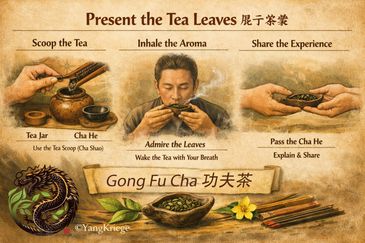
Although not crucial, many tea masters store the tea of choice in a designated tea jar before the ceremony to suit the overall tea aesthetic. During the start of the ceremony, use a tea scoop (cha shao) to scoop the tea leaves out of the jar and into the Cha He (a small, irregularly shaped contianer for displaying the tea leaves). From h
Although not crucial, many tea masters store the tea of choice in a designated tea jar before the ceremony to suit the overall tea aesthetic. During the start of the ceremony, use a tea scoop (cha shao) to scoop the tea leaves out of the jar and into the Cha He (a small, irregularly shaped contianer for displaying the tea leaves). From here, take the Cha He and inhale the aroma of the leaves, taking time to admire their shape and color. Tea masters also believe that the tea leaves will begin to wake up with our breath from this point. Then, if you are enjoying your tea ritual with other people, pass down the Cha He to the next person. At this point, you can also take the time to explain this tea to your guests. You can share the name of the tea, the type of tea, and some facts about it. Furthermore, you can share some personal stories and associations
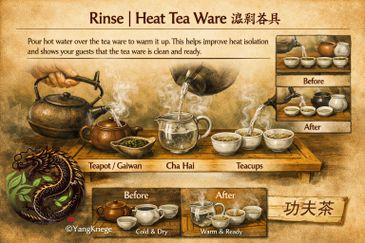
Pour hot water over the tea ware, starting from the teapot or gaiwan and going to the cha hai and teacups.
Warming up the tea ware is a crucial step to prepare it for the reception of the tea leaves. Also, it improves heat isolation and is also a way to show guests that the tea ware is clean
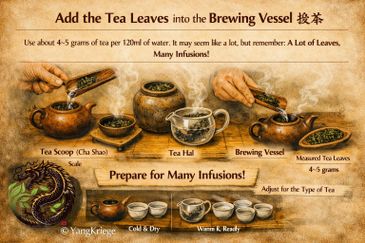
Before the tea ceremony, you can check how much tea leaves you will need. It will always depend on the tea you are brewing. However, for most teas, you will generally need about 4-5 grams of tea per 120ml. When you measure the tea leaves, it may seem like a lot. However, keep in mind that a tea session can last well over ten infusions, and people can enjoy many tea infusions with you!

Make sure you got your water to the right temperature for the tea that you will be brewing, and fill the brewing vessel to the brim. You can even let it overflow a little. Then, pour it out into your tea table after a few seconds. Rinsing tea is a somewhat optional step that not all practice. However, many will rinse their tea before dr
Make sure you got your water to the right temperature for the tea that you will be brewing, and fill the brewing vessel to the brim. You can even let it overflow a little. Then, pour it out into your tea table after a few seconds. Rinsing tea is a somewhat optional step that not all practice. However, many will rinse their tea before drinking it. The rinse will rid the tea leaves of dust and moisten and awaken them for further infusions. In any case, we always recommend rinsing your pu-erh tea and tightly rolled oolongs. You can also use this rinse to "bathe" your tea pet.
Brew the tea according to the tea variety, see chart above. Infusion timing will vary from variety and processing type, add around 10 additional seconds for each additional brewing. As before, fill the brewing vessel to the brim with water, even letting it overflow a little. If using a teapot, pour water over the teapot once you close the lid. It will improve heat retention for a nice brew.
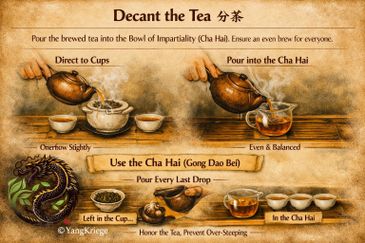
Pour the brewed tea into the bowl of impartiality (cha hai or gong dao bei). Having a cha hai is a special step in Chinese tea ceremonies so that everyone gets the same brew. Imagine you are pouring tea directly from the teapot and into the small teacups, naturally, someone will get a weak brew from the top, while the last person to rec
Pour the brewed tea into the bowl of impartiality (cha hai or gong dao bei). Having a cha hai is a special step in Chinese tea ceremonies so that everyone gets the same brew. Imagine you are pouring tea directly from the teapot and into the small teacups, naturally, someone will get a weak brew from the top, while the last person to receive tea will get the most potent last bit of the brew. Furthermore, when pouring tea from the brewing vessel and into the cha hai, make sure to pour every last drop, even if it seems like a slow process. We do this to honor the tea and prevent the tea leaves from over-steeping in leftover water.
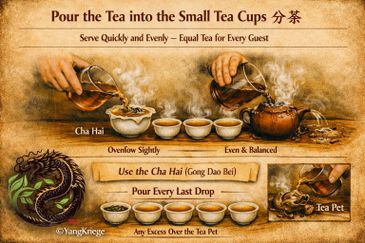
The next step will be pouring the brewed tea from the cha hai into everyone's teacup. Make sure to do this quickly and evenly. It is very important that each guest receives equal amount of tea, pour any excess over your tea pet.
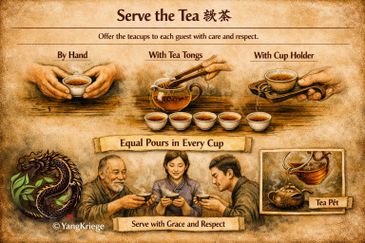
Pass around the teacups to each guest. To do so, some use their hands, while others might use specially designated tea tongs or a particularly shaped teacup holder
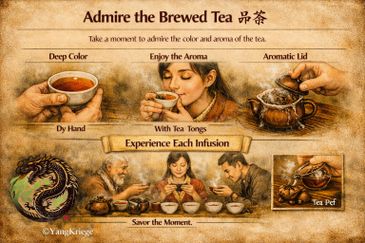
Sometimes we might choose to take some extra moments to admire the color of the brewed liquor and its unique aroma. Indeed, the smell of tea gradually transforms throughout the tea ceremony. Dry tea leaves, wet tea leaves, and every single tea brew — they all have a different scent.
Finally, now you can sip the tea and admire its unique taste. When tasting the tea, take small sips. Try not to drink it all at once. Let the tea sit in your mouth and notice its mouthfeel. Perhaps you will notice that it will never be quite like the previous time you brewed it, even when brewing the same batch of tea leaves. So many fac
Finally, now you can sip the tea and admire its unique taste. When tasting the tea, take small sips. Try not to drink it all at once. Let the tea sit in your mouth and notice its mouthfeel. Perhaps you will notice that it will never be quite like the previous time you brewed it, even when brewing the same batch of tea leaves. So many factors will impact the final taste of the tea, and it's always an interesting phenomenon to witness
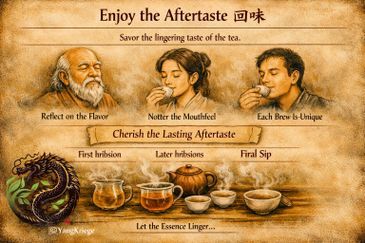
Now, after you have drunk the tea, enjoy its subtle aftertaste
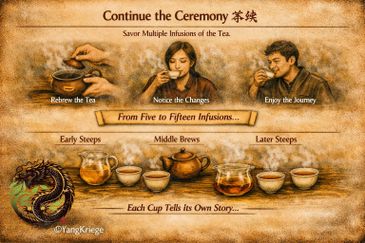
It's a common practice to smell the aroma of your teacup after sipping the tea, albeit usually after the end of the ceremony. Sometimes guests will even exchange and smell each other's teacups. You will be amazed to find out how different and unique each teacup can smell!